Why Clear Instruction Manuals are a Competitive Advantage: Lessons from IKEA and Beyond
- Peter, Instrux Studio
- Apr 10
- 2 min read
Updated: Apr 12
Clear, intuitive operating and installation manuals are critical for businesses because they directly impact customer satisfaction, product usability, and support costs. Well-designed manuals reduce errors, minimize returns, and empower users to confidently install and operate products without relying on customer service. Research shows that step-by-step visual instructions significantly improve comprehension by breaking complex tasks into manageable actions, reducing cognitive load and increasing task success rates.
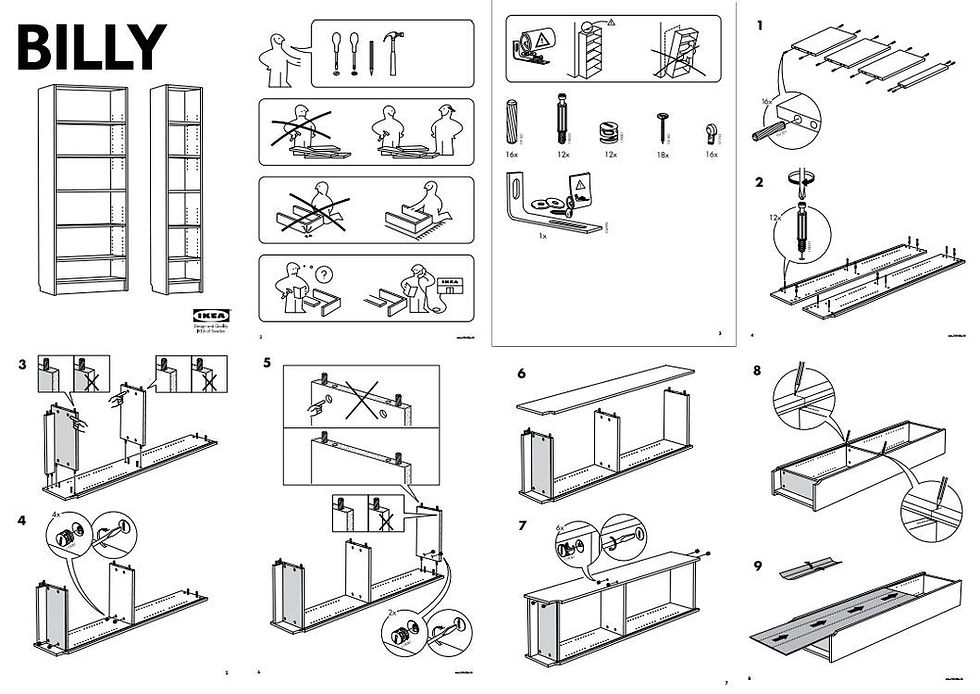
Few companies exemplify this better than IKEA, whose minimalist, image-driven manuals have become a global benchmark. By using simple, sequential visuals and eliminating unnecessary text, IKEA creates instructions that can be understood across languages and cultures, emphasizing clarity and continuity as core design principles.
Other organizations have adopted similar approaches. Companies like those using platforms such as StepAlong emphasize combining visuals with concise text to improve accessibility, reduce errors, and meet regulatory standards. Meanwhile, leading tech and product companies apply instructional design principles—such as progressive disclosure and visual hierarchy—to guide users through complex workflows.
Ultimately, clear manuals are not just documentation—they are a strategic business tool. When done well, they enhance the overall product experience, strengthen brand perception, and create a seamless bridge between product design and real-world use.
Beyond usability and cost savings, clear instructional design also plays a critical role in scalability and global reach. As companies expand into new markets, the need for documentation that transcends language barriers becomes increasingly important. IKEA’s reliance on visual, text-light instructions is a perfect example of how businesses can create universally understood materials. By minimizing reliance on written language, they reduce the need for extensive translation while ensuring consistency across regions. This not only lowers localization costs but also accelerates product rollout in international markets.
Another often overlooked benefit of well-designed manuals is their impact on internal efficiency. Clear instructions aren’t just for end users—they also support internal teams such as installers, service technicians, and customer support representatives. When documentation is intuitive and standardized, it becomes easier to train staff, onboard new employees, and maintain consistent service quality. In contrast, poorly structured manuals force teams to rely on tribal knowledge, increasing the risk of errors and inconsistencies across operations.
Clear documentation also contributes to product perception and brand differentiation. In competitive markets where products may be similar in function and price, the overall user experience becomes a key differentiator. A seamless installation process, guided by well-crafted visuals, can leave a lasting positive impression. Customers are more likely to trust and recommend a brand that makes their experience easy and frustration-free. In this way, instructional design becomes an extension of the product itself—not just a supporting asset.
Finally, as digital experiences continue to evolve, the principles behind IKEA’s approach are becoming even more relevant. Whether in printed manuals, mobile apps, or interactive guides, the emphasis on clarity, simplicity, and visual communication remains constant. Businesses that adopt these principles position themselves to adapt more easily to emerging formats, such as augmented reality instructions or interactive onboarding experiences.
In the end, great documentation is not about adding more information—it’s about delivering the right information, in the clearest possible way. Companies that embrace this mindset don’t just reduce friction; they create experiences that are intuitive, scalable, and aligned with how people naturally learn and interact with the world around them.


Comments