Use Case: Standardizing Coffee Truck Operations Through Technical Illustration
- Peter, Instrux Studio
- Apr 18
- 3 min read
Running a high-volume mobile coffee truck presents a unique operational challenge: speed, consistency, and customer experience all need to align in a fast-paced, often unpredictable environment. For a US-based mobile coffee truck client, the solution wasn’t more training sessions or longer written manuals—it was a fully illustrated operating guide designed to communicate clearly, quickly, and intuitively.

The Challenge
The client needed a comprehensive staff manual that could be used by baristas with varying levels of experience. The scope was broad:
How to prepare specific drinks (espresso-based and specialty)
How to greet and interact with customers
Handling difficult or problematic customer situations
Managing order errors and service recovery
Troubleshooting technical issues with equipment
Standard operating procedures (setup, cleanup, daily flow)
Traditional text-heavy manuals had proven ineffective. Staff either didn’t read them or struggled to apply them in real-time. The environment demanded something faster—a system that could be understood at a glance.
The Approach: Illustration as Operational Language
The solution was to design a visually driven operating manual, where illustration carried the primary communication load, supported by concise, carefully edited copy.
Each section was built as a repeatable visual system:
Clear hierarchy (titles, steps, key metrics)
Minimal but precise text
Consistent iconography and layout structure
Visual cues guiding the eye through processes
The goal was not decoration—it was decision support under pressure.
Example: Espresso Standardization
One of the most critical components was drink consistency. The espresso guide (shown above) translates technical variables—dose, yield, and time—into an intuitive visual reference.
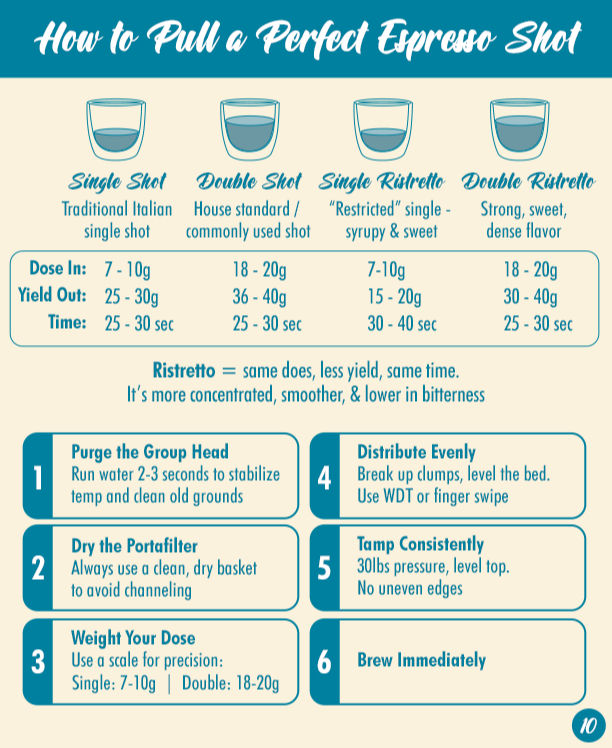
Rather than relying on paragraphs of explanation, the diagram:
Compares shot types side-by-side
Uses simple visual containers to show differences
Standardizes key metrics (grams, seconds)
Reinforces learning through layout repetition
This allows staff to quickly calibrate their output without second-guessing or interrupting workflow.
Beyond Drinks: Human Interactions & Edge Cases
What makes this project particularly impactful is that it extends beyond “how to make coffee.”
Illustrated scenarios were developed for:
Customer greetings → tone, posture, and phrasing
Handling complaints → step-by-step de-escalation flow
Order mistakes → clear recovery protocol
Technical issues → quick troubleshooting trees
These are areas where written manuals typically fail. In contrast, visual frameworks allow staff to:
Recognize situations instantly
Follow structured responses
Act confidently without overthinking
In high-pressure service environments, that clarity directly impacts customer experience.

Why Illustration Outperforms Text
This project reinforces a key principle: well-designed illustrations reduce cognitive load.
Compared to traditional manuals, illustrated systems:
Eliminate ambiguity
Improve retention and recall
Enable faster onboarding
Reduce reliance on supervision
Create consistency across teams
Importantly, the illustrations were paired with tight, copy-edited language—ensuring that every word earned its place and supported the visual.

The Outcome
The final deliverable was a cohesive operating manual that staff could actually use—on shift, in real time.
Instead of flipping through dense pages, baristas and staff now reference:
Quick visual guides for drinks
Scenario-based frameworks for service
Step-by-step operational checklists
The result is a more confident team, more consistent product, and a smoother customer experience.
Takeaway
Operating manuals are often treated as an afterthought—but in reality, they are frontline tools. When designed properly, they become a silent trainer, a quality control system, and a brand ambassador all at once.
This project demonstrates how technical illustration—when done with clarity, structure, and intent—can transform complex operations into intuitive, repeatable actions.


Comments